


#1 VERNACULAR INSIGHTS - Vernacular ways to deal with the floods
Updated: Feb 2
How does traditional architecture offer solutions in the event of natural disasters?
Welcome to the first edition of Vernacular Insights.
With this series, we invite you to explore the intersection of ancestral wisdom and contemporary challenges. Our goal is to highlight the practices and the dedicated professionals who prove, day after day, that vernacular architecture is not a relic of the past, but a resilient blueprint for the future.
We begin this journey with a reflection sparked during the Festival de Arquitectura in Mérida this past August. Amidst the vibrant discussions, one question stood out with striking urgency: How can traditional architecture help us respond to natural disasters?
As we witness the devastating impact of recent floods in Spain, Italy, and Nigeria, this question is no longer theoretical, it is vital. This post draws inspiration from the compelling lecture delivered by Eve Nanji (add.apt studio) regarding the situation in Anambra, Nigeria. We thank her for providing such a valuable perspective on how local knowledge can offer concrete solutions to global crises.
Anambra in numbers
Location: Anambra is a state in southern Nigeria. It lies in a low-lying area, with part of its boundary formed by the Niger River. Another important watercourse influencing the region is the Benue River, which joins the Niger farther north.
Area: 4,844 km2
Population: 6,953,500 (year 2022)
Climate: Tropical Savanna climate
Economy: agriculture as a main economic sector

Understanding Flooding
Among the many regions grappling with flooding, Anambra in Southern Nigeria stands out. There, residents are asking a profound question: “Owu gini?” – Why?
Why do these floods continue to devastate their communities, and what solutions do they have?
To understand this, it’s useful to outline the common causes of flooding, both natural and human-made:
Rapid and excessive rainfall, especially near rivers
Tropical cyclones and tsunamis in coastal areas
Irresponsible urbanization and the proliferation of non-permeable surfaces
Deforestation
Draining of wetlands (critical natural water storage systems)
Poorly planned infrastructure, such as dams that disrupt natural water flow
Overly intensive agricultural practices
Inadequate drainage systems
Pollution-blocked waterways
We marked two causes that stand out in Anambra, and importantly, neither were influenced by the inhabitants themselves. Yet they now bear the consequences.
According to the International Organization for Migration, between 28 October and 8 November 2024, floods affected 37 locations across Anambra State.
In the seven local government areas assessed, 54,422 individuals in 10,272 households were impacted.
23% of affected homes were habitable but needed repair
12% were partially damaged
3% were completely destroyed
Agriculture, a primary livelihood, was severely hit as fields remain underwater. This was a key concern highlighted by Eve Nanji during her presentation.
Problematics
--> The main factors contributing to the current challenges include impact of the Lagdo Dam in Cameroon. When the dam releases water, low-lying areas downstream experience significant flooding.
--> Conversely, the construction of the Kainji Dam in Nigeria eliminated annual flooding, enabling expanded agriculture and rapid settlement growth. Over time, this led to widespread tree clearing for farmland—leaving the region without the dense forests it once had, which means leaving it without the natural water storage system.
Actions
No matter where a project takes place and what are the reasons behind the crisis, an extensive research is essential in the first place. In this case, the work spanned geological, environmental, hydrological, and urban studies, as well as existing building surveys and analyses of local food and water resources. All in order to better understand what is the context of the place, because only in this way we can know what are the actual needs, what may work as a possible solution and what will not be an appropriate action.
Among these efforts, one stood out in particular: the study of the traditional Anambra house.
What Traditional Architecture Can Teach Us
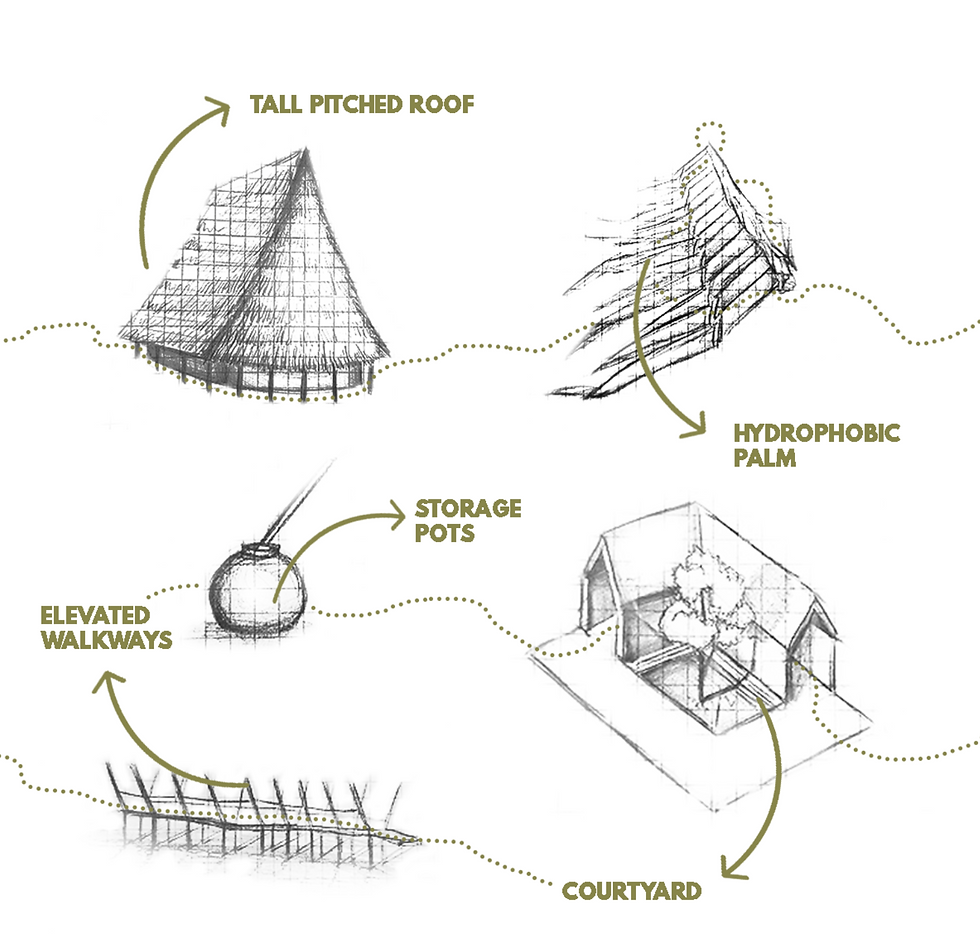
This analysis of the traditional Anambra houses revealed several resilient, climate-adaptive features:
1. High-pitched roofs
Not just for ventilation, the arch inside was traditionally used as elevated storage for valuable belongings, protecting them from floodwaters.
2. Hydrophobic palm materials
These natural materials helped prevent water from entering the house.
3. Bamboo water-storage pots
Essential in crisis situations, providing access to fresh water when flooding compromised supply.
4. Courtyard-based house typology
The courtyard played a crucial symbolic and ecological role. It was not only a symbol of new beginnings, where people planted a tree in the year they built the house, but the trees and vegetation also served as natural rainwater collectors, the hydrophilic element.
5. Elevated walkways
These kind of structure enabled mobility during periods of high river levels. Some of them remain till today, but are too low to cope with the increased water levels brought by climate change.
Proposed Solutions Rooted in Vernacular Wisdom
After analyzing the key challenges, the team proposed several solutions inspired by traditional knowledge and local building practices that the survey of the traditional architecture brought them. In their strategy they marked several points.
1. Protecting precious belongings and crops
Recognizing that crops are a primary source of livelihood, they focused on strategies to safeguard them during floods. This includes reintroducing tall pitched roofs and using water-resistant materials, such as palm leaves, to better protect household belongings, so they can serve during and after the flood events.
2. Re-establishing courtyards as rainwater catchment systems
The team proposed re-introducing the traditional role of courtyards as natural water-storage areas. These spaces can help direct excess water safely away from living areas while also supporting irrigation for home gardens.
3. Coming back to the traditional wall construction
Lastly, they recommended bringing back the use of malleable clay walls reinforced with bamboo. This method increases structural resilience and helps buildings better withstand the force of floodwaters, reducing the need for families to relocate after major events.
This exploration of Anambra’s traditional architecture is a powerful reminder:
Local knowledge often holds answers to modern crises.
By revisiting vernacular wisdom, we can uncover resilient, sustai nable, and culturally meaningful solutions for communities facing climate challenges.
Sources (30.11.2025):


Comments